Tyler Roof Repair provides commercial roof repair in Tyler, TX and across East Texas, serving business owners who need honest assessments and durable results without being pushed toward unnecessary replacements. Whether you are dealing with a leaking TPO membrane, damaged flashing, standing water issues, or wear from East Texas heat and seasonal storms, our licensed and fully insured crew diagnoses the problem accurately and repairs it right the first time. We have worked commercial roofing in this region for over 20 years, with experience on flat roofs, metal systems, modified bitumen, and more. Tyler Roof Repair is BBB Accredited, giving local business owners a verified record to check before they book. Repairs are our first recommendation when the roof can support them, because we built this company around saving you money, not spending it. Call 903-426-1151 any time, day or night.
The commercial buildings we work on across East Texas run from strip retail and restaurants to warehouses, medical offices, churches, schools and multi-unit apartment properties. Almost all of them carry a low-slope membrane rather than shingles, and that changes where the roof fails. Commercial roofs rarely give out across the field. They fail at seams, at penetrations and curbs, and at drains, which is why most of what looks like a replacement is a repair once somebody actually gets up there and looks.
Commercial Roofing Systems We Repair in Tyler TX
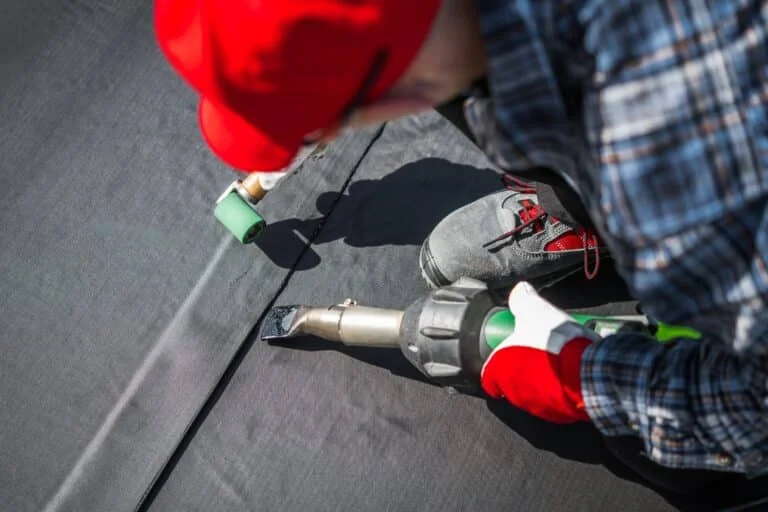
- TPO (Thermoplastic Polyolefin) - most common commercial flat roofing in Texas; we repair membrane seams, flashings, and penetrations
- EPDM (Rubber Roofing) - repair of blisters, seam failures, and punctures
- Modified Bitumen - repair of alligatored surfaces, open seams, and ponding water damage
- Metal Roofing - seam sealing, panel replacement, fastener corrosion repair, skylight flashings
- Built-Up Roofing (BUR) - repair of gravel displacement, surface erosion, and base sheet failure
- Shingle Roofing on commercial buildings - repair and matching replacement of wind/hail-damaged sections
Signs Your Commercial Roof in Tyler Needs Immediate Repair
- Active ceiling leaks or water stains inside the facility
- Visible membrane punctures, blisters, or open seams on the roof surface
- Standing water (ponding) remaining 48+ hours after rainfall
- Interior insulation that has been wet - wet insulation loses R-value and promotes mold
- Flashing separation around HVAC units, skylights, or parapet walls
- Storm damage following a hail or high-wind event - always get a post-storm inspection before filing a claim
Commercial Roof Repair Process - Tyler TX
Every commercial repair begins with a comprehensive roof inspection. We document all damage with photos, provide a written repair scope, and give you a firm quote before any work begins. For insurance-related repairs, we provide documentation support to help expedite your claim.
What Commercial Clients Actually Need From a Roofing Contractor
A leaking commercial roof is a business problem as much as a building problem. Every hour of disruption has a cost: water-damaged inventory, closed office space, tenants calling to complain. What you need from a contractor is a fast assessment, a clear scope of work, and a crew that shows up when they say they will.
What you don’t need is a contractor who shows up to a $3,000 repair job and recommends a $40,000 replacement. That happens more than it should in commercial roofing. Our approach is to document exactly what’s wrong, explain what fixing it actually entails, and give you a written scope before any work starts. If replacement is genuinely necessary, we’ll tell you that too, with the photos and documentation to back it up.
For property managers handling multiple buildings, we also provide ongoing inspection schedules and maintenance records that satisfy most commercial property insurance requirements. A properly maintained roof with a paper trail is worth real money when a claim comes in after a storm.
Why East Texas Weather Damages Commercial Roofs
Commercial roofs in this region fail in a specific set of ways, and the causes are climatic rather than random. Prolonged summer heat drives membrane expansion and contraction that stresses seams and fasteners over years, which is why seam separation on TPO and EPDM is the single most common commercial repair we perform. Heavy spring rainfall puts drainage systems under pressure and exposes every low spot where ponding has developed. Hail creates surface damage that is often invisible from the ground and does not leak immediately, but leaves the membrane vulnerable to moisture intrusion over the following months.
The practical consequence is that a commercial roof in East Texas should be inspected after severe weather even when nothing is leaking. The damage that turns into a five-figure problem next spring is usually visible this week.
Why Repair Should Come Before Replacement
A commercial roof replacement is a capital expense that disrupts operations and requires real planning. A well-maintained roof with localized problems can usually be repaired for a fraction of replacement cost, extending its useful life by years when the work is done correctly.
Everything depends on accurate diagnosis. A contractor who recommends replacement after a brief visual walk, without testing the membrane, checking the insulation layers, or measuring moisture content in the substrate, has not given you a reliable assessment. Ask what they tested and how. If the answer is vague, get a second opinion before you approve a replacement.
Storm Damage and the Insurance Claim Process
When severe weather damages a commercial roof, documentation determines how the claim goes. A contractor who photographs and reports damage accurately, organizes the findings clearly, and works directly with your adjuster is the difference between a claim that processes and one that turns into a dispute.
Two things are worth doing before you file. Have a qualified contractor inspect and document the damage independently, rather than relying solely on the adjuster’s assessment. And do not sign paperwork authorizing repair or replacement until you understand exactly what is being proposed and what it will cost.
How to Vet a Commercial Roofing Contractor
Commercial work carries risks that residential work does not, so the checks are different:
- Confirm material-specific experience. Ask how many commercial flat roofs they have repaired in the past year, and specifically which systems. A contractor who mainly does residential shingle work may not correctly diagnose a TPO or EPDM failure.
- Verify licensing, bonding, and insurance for commercial scope. General liability should cover the full project, and workers’ compensation is essential when a crew is on your building.
- Check the public record. Our BBB profile and Google reviews are both public, and any contractor you consider should have the same.
- Get a written scope and quote before work starts. Not a verbal estimate, and not after the crew has already opened up the roof.
Request a free commercial roof assessment and we’ll get out to your property within 24 hours.